

Large RMS models aren’t built for EMT.
Wide-area RMS models carry tens of thousands of buses, node-breaker substations, split-up circuits and distribution detail that an EMT simulation has no use for. These tools get the model ready for conversion, then show with measurements where the EMT study boundary should sit.
- No.
- 04
- Type
- RMS to EMT
- Client
- Internal tooling
- Our role
- Tool development and boundary studies
- Inputs
- PowerFactory, PSS®E
- Output
- EMT-ready model for PSCAD
- Part of
- Velon Suites
- Status
- In use
With inverter-based plant and very large loads such as data centres joining the grid, more connections now need EMT studies before an offer is made. The slow part is usually the model: getting a wide-area RMS model into EMT with a boundary the system operator accepts.
Three things stop a wide-area RMS model converting to EMT.
Too big for the EMT solver
Tens of thousands of buses, deep distribution feeders and neighbouring networks. None of it matters to the study, but all of it slows the simulation. It has to be reduced, not ignored.
Topology the converter rejects
Node-breaker substations with hundreds of switch nodes, multi-segment circuits, duplicate IDs and out-of-service clutter. Any of these can make an RMS to EMT importer fail before a simulation starts.
Boundaries drawn by habit
Even after a clean conversion, the study area is usually drawn by judgement. Too wide wastes solver time; too tight distorts the impedance seen at the POI. Neither holds up in a system-operator review.
Part 01 fixes the first two in the RMS model, before anything is converted. Part 02 fixes the third by placing the boundary with a repeatable measurement.
Also in Part 01. Scripts that collapse node-breaker substations and merge and clean up circuits run alongside the DSO reduction, so the importer gets a model it accepts.
Harmonic impedance scan
The study area has to reproduce the full network’s harmonic impedance at the POI. Grow the boundary one substation at a time, re-scan each time, and stop when the reduced scan matches the reference within the agreed threshold.
Open tool →03Voltage-dip screening
Apply a three-phase fault at the connection point and find where residual voltage recovers above the operator’s threshold. That boundary is the study area for FRT and protection screening.
Open tool →Three tools, one pipeline.
Climb until a leakage path stops you, then place a Ward equivalent.
An importer brings every node of a big PowerFactory model into EMT, far more than the study needs. This tool trims the distribution network under a grid supply point first, in RMS. It climbs from the 11 kV feeders until a leakage path (a second route back into the network) blocks a clean cut, then places a Ward equivalent that holds power flow and fault level at that boundary.
Try itPick a GSP on the map or search for one, click a red tie to add or remove a leakage path, then run the reduction. Switch to naïve radial to see what ignoring the ties does.
The full distribution network under the GSP.
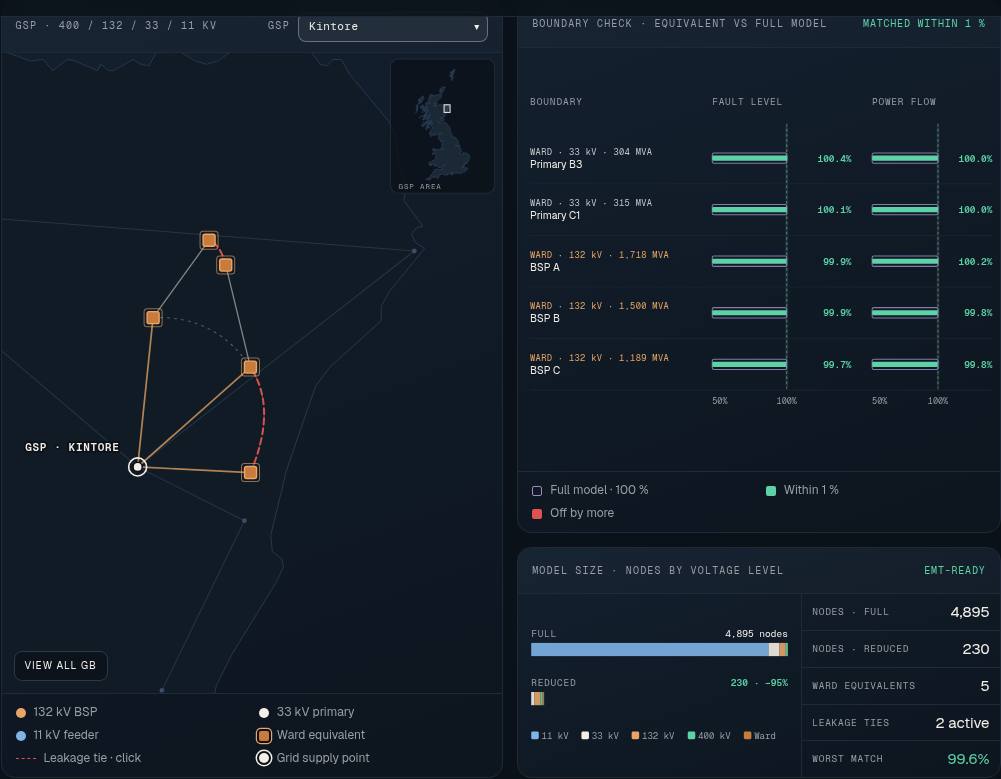
This is an illustrative example only.
| Nodes · full | – |
|---|---|
| Nodes · reduced | – |
| Ward equivalents | – |
| Leakage ties | – |
| Worst match | – |
How it works
- 1Select the GSPSearch or click the map
- 2Find leakage pathsTies back into the network
- 3Aggregate feeders11 kV into 33 kV
- 4Climb until blockedWard where a tie stops it
- 5Check the boundaryFault level, power flow
- 6Export to PowerFactoryRMS case ready for EMT
Why honour leakage paths
Forcing every feeder up to one boundary drops the second paths back into the network, so the boundary fault level comes out wrong.
The climb stops wherever a leakage path blocks a clean cut and places a Ward equivalent that holds power flow and fault level.
Why pre-condition first
Node-breaker detail and DSO networks make a planning case slow and fragile once converted to EMT.
What the scripts do
Python and DPL scripts aggregate DSO networks, collapse node-breaker substations and merge multi-segment circuits, keeping topology, impedances and plant.
How it is checked
The simplified case is compared with the original so MIIF, UIF and boundary conditions do not materially change.
The distribution network under each GSP is generated for illustration: BSP, primary and feeder positions, loads, node counts and leakage ties are indicative. The 400 kV fault level comes from the same GB network model as the voltage-dip tool; lower-voltage fault levels follow typical transformer and circuit impedances. Coastline: Natural Earth (public domain).
Grow the boundary until the scans match.
Pick a point of interconnection and the tool grows the retained area substation by substation, re-scanning the harmonic impedance each time. It stops once the reduced scan matches the full network within your tolerance.
Try itClick a substation on the map or search for one, set the two tolerances, then press run.
First the full network is scanned at the POI to give the reference |Z|(f).
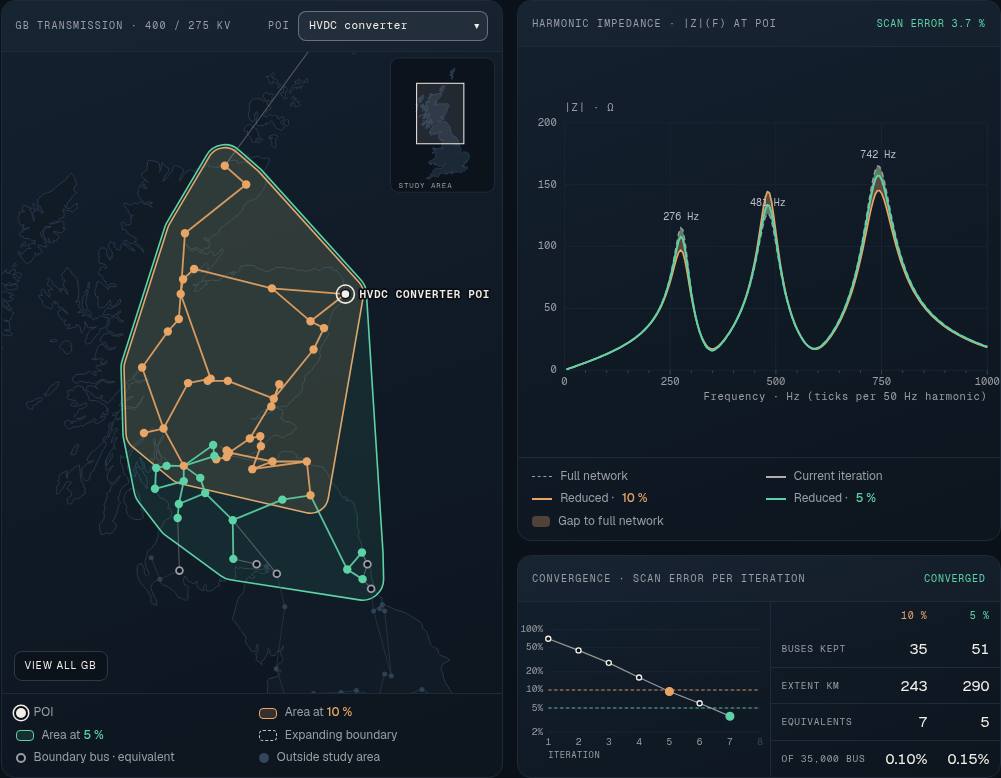
This is an illustrative example only.
| 10 % | 5 % | |
|---|---|---|
| Substations kept | – | – |
| Extent km | – | – |
| Equivalents | – | – |
How it works
- 1Select the POISearch or click the map
- 2Define error toleranceTwo layers, % scan error
- 3RunFull-network scan, then expand
- 4Tool decides the areaStops when the scan matches
- 5Automatic model reductionTSO area + boundary equivalents
- 6Export to PowerFactoryReady for EMT
Why measure the boundary
Ranks converter interaction risk. It never checks the impedance the retained area presents at the POI.
Grows the area until |Z| at the POI matches within tolerance, then exports the reduced model to PowerFactory.
Scan error: RMS difference between reduced and full-network |Z| over 5–1000 Hz, relative to the RMS of the full-network |Z|. Coastline: Natural Earth (public domain). Substation locations, circuits and scan curves are indicative.
Apply the fault. Watch the dip spread.
Pick a fault location and apply a bolted three-phase fault. Every substation whose retained voltage falls below the fault-ride-through threshold joins the study area, and the substations on its edge become boundary equivalents.
Try itClick a substation on the map or search for one, pick the FRT threshold and grid strength, then apply the fault. Turn on the 120 km radius to see what a fixed boundary would miss.
Pre-fault, every substation sits at 1.0 p.u.
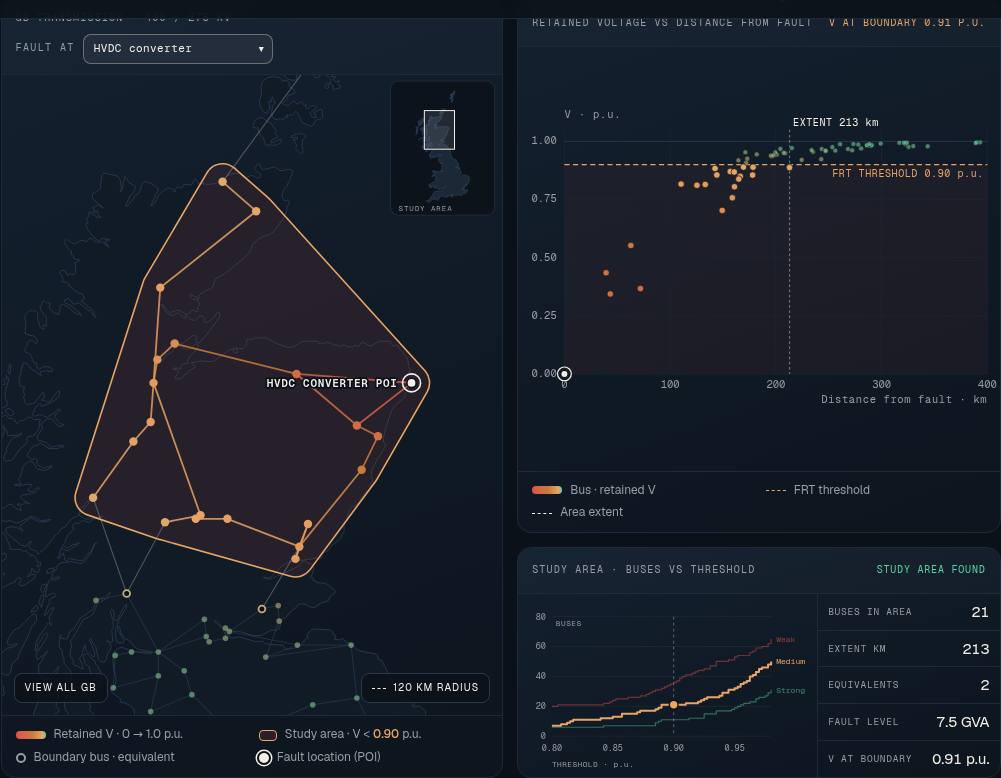
This is an illustrative example only.
| Substations in area | – |
|---|---|
| Extent km | – |
| Equivalents | – |
| Fault level | – |
| V at boundary | – |
How it works
- 1Select the fault locationSearch or click the map
- 2Set threshold & grid strengthFRT level, fault level
- 3Apply 3-phase faultBolted fault at the POI
- 4Retained voltage at every substationFrom the network impedance
- 5Tool decides the areaSubstations below threshold
- 6Export to PowerFactoryReady for EMT / FRT studies
Why measure the boundary
A fixed radius ignores fault level. In a weak area, converters beyond the cut still see the dip.
Keeps every substation whose retained voltage falls below the FRT threshold, then exports the area to PowerFactory.
Retained voltage: V = 1 − Z(j,f) / Z(f,f) from the network impedance matrix for a bolted three-phase fault, pre-fault 1.0 p.u., loads neglected. Circuits are modelled as reactance per km and generation as a source behind every substation, scaled by grid strength. Coastline: Natural Earth (public domain). Substation locations, circuits and voltages are indicative.